Single Variable Complex Analysis: Riemann Surfaces and Automorphisms

30 minute read

Published:

Much of this note is based on John Milnor’s Dymamics in One Complex Variable. Let’s begin by reviewing some single variable complex analysis on $\mathbb{C}$. A map from $f:\mathbb{C} \to \mathbb{C}$ is complex differentiable if $f$ is a differentiable map when considered as a real map $f:\mathbb{R}^2 \to \mathbb{R}^2$ and moreover, its linearization at each point commutes with the action of multiplication by $i$ which, as a real map, can be written as the matrix $\begin{pmatrix} 0 & 1 \ -1 & 0 \end{pmatrix}$. From this, one derives the Caucy-Riemann equations. Another term used to describe such maps is holomorphic. One can also prove that when using the usual dot product of $\mathbb{R}^2$ to define lengths and angles, a holomorphic map $f$ is conformal whenever $f’(z) \neq 0$; i.e. it preserves angles. The proof is simply to show $\dfrac{\langle df_z(v),df_z(w) \rangle}{|df_z(v)||df_z(w)|}=\dfrac{\langle v,w \rangle}{|v||w|}=:\cos \theta$.

Now, let $D \subset \mathbb{C}$ denote the open unit disk and let $\widehat{\mathbb{C}} = \mathbb{C} \cup \infty$ denote the Riemann sphere which is topologically a sphere which we might think of as the one-point compactification of $\mathbb{C}$.

Schwarz Lemma: Let $f:(D,0) \to (D,0)$ be a holomorphic map such that $f(0)=0$. Then $|f(z)| \leq |z|$ and $|f’(0)| \leq 1$. Moreover, if we have equality at $z \neq 0$ for the first inequality or equality for the second inequality, then in fact $f(z) = cz$ where $|c|=1$; i.e. it is simply a rotation.

The main point of this lemma is that under the usual Euclidean norm, the distance between every $z \in D$ and 0 never increases and in fact, is usually distance decreasing unless the map is a rotation.

Proof: The map $g(z) = f(z)/z$ is actually holomorphic (with target being $\mathbb{C}$) because the Taylor series centered at 0 has no constant term. Since there is no pole for $f$ at $z=0$, we can extend $g$ to $z=0$ by setting it equal to $f’(0)$. Let $D_r$ be a closed disk centered at the origin with $r<1$. By the maximum principle, restricting $g$ to $D_r$ cannot have interior maximum so the maximum must be on the boundary, call it $M$. So $|g(z)| \leq |g(M)| =|f(M)|/r \leq 1/r$. As we let $r \to 1$, we see $|g(z)|\leq 1$ which shows $|f(z)|\leq |z|$. If we had equality, this means there is a maximum on the interior, implying $g(z) = a$, a constant map. Hence $f(z) = az$ for $|a|=1$. The above argument also shows then that $|f’(0)| \leq 1$. $\square$

Now, a Riemann surface $X$ is a topological space which is locally conformally homeomorphic to open subsets of $\mathbb{C}$ and hence, an orientable 2-manifold. It is simply-connected if every continuous map $S^1 \to X$ can be continously deformed to a point. Two Riemann surfaces are conformally equivalent if there exists a map between them which is conformal and has a conformal inverse. We now state a very important theorem:

Uniformization Theorem: There are only three simply connected Riemann surfaces, up to conformal equivalence:

  1. The Riemann sphere $\widehat{\mathbb{C}}$ (aka complex projective line)
  2. $\mathbb{C}$ (aka the complex affine line)
  3. $D$, the open disk (which inherits the complex structure of $\mathbb{C}$)

Regarding how I named these three, it’s a fairly trivial matter to see that $\widehat{\mathbb{C}} \cong \mathbb{CP}^1$ (write down explicit maps) but I won’t really be using the algebraic geometry term as much. For $\mathbb{C}$, I will refer to it as a complex line.

For a geometric point of view, recall that for a 2-manifold $S$, scalar curvature is twice that of the Gaussian curvature $K:S \to \mathbb{R}$. The Riemann sphere admits a metric of positive scalar curvature, the complex line admits a flat metric, and the disk admits a metric of negative scalar curvature called the Poincaré metric which has constant Gaussian curvature $-1$. In fact, there’s more to this.

Theorem: Every Riemann surface $S$ is conformally isomorphic to a quotient $\tilde{S}/\Gamma$ where $\tilde{S}$ is one of these three Riemann surfaces. The quotient is by the action of a group $\Gamma \cong \pi_1(S)$ acting freely, properly discontinuously, by conformal automorphisms on $\tilde{S}$.

A Riemann surface can typically be described by the number of punctures $n$ that it has and the genus $g$. If $2g+n \geq 3$, then it is covered by the open disk $D$. The topology of Riemann surfaces covered by the complex line or open disk are rather simple in the sense that they have no nontrivial higher homotopy groups, only fundamental groups and the ones covered by the open disk have nonabelian fundamental groups while those covered by $\mathbb{C}$ have abelian fundamental groups.

For example, $\exp:\mathbb{C} \to \mathbb{C}^*$ is a covering for the annulus. We also have many lattices $\Lambda \cong \mathbb{Z}^2 \subset \mathbb{C}$ and these give rise to elliptic curves, many of which are not conformally equivalent. Similarly, if we want to create a closed Riemann surface from $D$, we can pick a $4g$-gon ($g \geq 2$) and find the action of a Fuchsian group to glue the proper edges together. The disk can be covered by this polygon and the result is a genus $g$ Riemann surface.

Brief aside: For closed Riemann surfaces $\Sigma$ of genus $g$ with marked points $n$ such that $2g +n \geq 3$ and a given almost complex manifold $(X,J)$, there is a moduli space of holomorphic maps $\Sigma \to X$ where the equivalence is defined by automorphisms of $\Sigma$ that send markings to markings. The context in which this first arose is in algebraic geometry, where Riemann surfaces are viewed as algebraic curves. The reason for the $2g+n \geq 3$ is to have stable curves; i.e. have finitely many automorphisms. For example, the Hurwitz bound says that the number of automorphisms on a stable curve of arithmetic genus $g \geq 2$ is at most $84(g-1)$. It is less when we impose markings. This moduli space and a natural compactification of that space called the Deligne-Mumford moduli space $\overline{\mathcal{M}}_{g,n}(X)$ which allows for nodal degenerations and bubbling. A special case is if $X$ is just a point. In that situation, there is a way to construct $\overline{\mathcal{M}}_{g,n}$ from an augmented Teichmüller space $\bar{T}_{g,n}(\Sigma)$. The interior of this space is homeomorphic to a ball but itself also has complex structure and complex dimension $3g-3+n$. The interior of this Teichmüller space is constructed from the set of complex structures on $\Sigma$ modulo diffeomorphisms which are holomorphic and isotopic to the identity map on $\Sigma$.

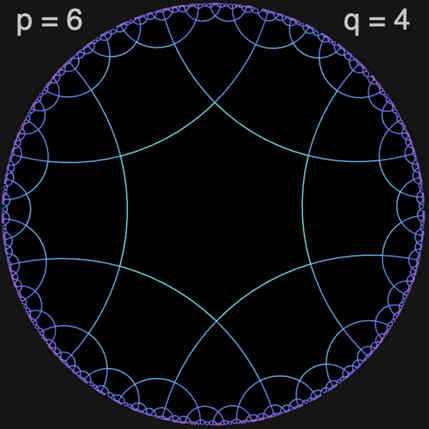
Back to our simply-connected Riemann surfaces, we’ve mentioned above the Poincaré metric $\rho$ on $D$. The definition is $\rho(x,y) = \tanh^{-1}\left|\dfrac{x-y}{1-\bar{x}y}\right|$ and it has constant Gaussian curvature $-1$ so it’s an example of a hyperbolic metric. The Schwarz lemma above was about holomorphic maps being distance decreasing for the usual Euclidean distance but in fact, they are distance decreasing for the Poincaré metric as well, a theorem of Pick. This is very interesting because we then see that a biholomorphism $f:D \to D$, having an inverse, leads us to conclude that $\rho(f(x),f(y)) = \rho(x,y)$; i.e. conformal equivalences (aka biholomorphisms) preserve the hyperbolic metric on $D$! If we draw the geodesics on the disk, they will look like either Euclidean straight lines or Euclidean circles that intersect the boundary at right angles. Here is a nice tiling of the disk by pentagons such that each vertex is shared by 4 other pentagons (see below for the tiling applet that generated this image).

label

In fact, we can generalize even further, a result due to Alfohrs (first recipient of the Fields Medal). Let $(S,\sigma)$ be a Riemann surface with metric such that the Gaussian curvature $K_\sigma \leq -1$. Then a holomorphic map $f:(D,\rho) \to (S,\sigma)$ is distance decreasing; i.e. $\sigma(f(x),f(y))\leq \rho(x,y)$. There’s actually an even further generalization due to Yau (also a Fields medalist). Let $(T,\tau)$ be a Riemann surface with $K_\tau \geq -1$ and $K_\sigma \leq -1$ still. We can use the metrics to define arclength of paths (the distance between points is determined by geodesics). Then a holomorphic map $f:(T,\tau) \to (S,\sigma)$ decreases arclength.

So we now know that holomorphic maps are restricted to distance decreasing maps when going from Riemann surfaces that are less negatively curved to those that are more negatively curved. Of course, the obvious inclusions show there are maps going the other way, from negative to positive: $D \hookrightarrow \mathbb{C} \hookrightarrow \widehat{\mathbb{C}}$. But in fact, going the other way, there are no nontrivial maps; so not only are maps distance decreasing, they are constant maps which obviously decrease distance to zero. To show there are no maps $\widehat{\mathbb{C}} \to \mathbb{C}$ or to target $D$, the maximum principal shows the maximum has to be obtained on the boundary and not interior or else the map is constant. But here, the boundary is empty and the Riemann sphere is compact so all continuous maps have realized maxima. Liouville’s theorem shows that bounded entire functions are constant so $\mathbb{C} \to D$ must be constant. Since Riemann surfaces are always quotients of one of the three simply-connected Riemann surfaces, then we can lift any map $f:S \to T$ to the universal covers and apply the arguments we just gave. In other words, all holomorphic maps from positively curved Riemann surfaces to flat or negatively curved ones are constant and similarly from flat to negatively curved surfaces.

Example: The Riemann sphere with 3 points removed can be viewed as the complex line with two points removed. Since this is an example where $2g +n \geq 3$, then a holomorphic map $f:\mathbb{C} \to \mathbb{C} \setminus {a,b}$ is in fact constant because the target admits a metric of negative curvature. This result is known as Picard’s little theorem and tells us that holomorphic maps $\mathbb{C} \to \mathbb{C}$ are almost surjective, missing at most one point; e.g. $\exp: \mathbb{C}\to \mathbb{C} \setminus {0}$.

Automorphisms of Simply-Connected Riemann Surfaces

An automorphism of a Riemann surface $S$ is a conformal equivalence $f:S \to S$. On the Riemann sphere, rational maps are polynomials divided by polynomials; these have zeros and poles. The automorphisms are the rational polynomials where the numerator and denominator are both linear polynomials, giving us something of the form $\dfrac{az+b}{cz+d}$ where $ad-bc = 1$. We can identify these with the group $SL(2,\mathbb{C})$. Since the matrices $\pm \text{Id}$ give the same map, we quotient by them and obtain $PSL(2,\mathbb{C})$ as the group of automorphisms of $\widehat{\mathbb{C}}$. These also go by the name of Möbius transformations. The maps, being conformal, preserve angles. Since circles in $\mathbb{C}$ are the only curves with constant curvature, these automorphisms send circles to circles. We think of a straight line as a circle of infinite radius. A nice way to think about Möbius transformations is by placing a unit sphere above the plane plus a point at infinity and using stereographic projection. We perform certain rigid motions of the sphere to get the Möbius transformations; this video explains it. In fact, stereographic projection from the round sphere $S^n \setminus {N} \to \mathbb{R}^n$ for any dimensions $n$ is a a conformal diffeomorphism.

For $\mathbb{C}$, the automorphisms are of the form $\lambda z + c$ where $\lambda \neq 0$. So these can be identified with the group $\mathbb{C}^* \times \mathbb{C}$. Put another way, these are affine transformations.

Lastly, the automorphisms of the unit disk are of the form $f(z) = e^{i\theta} \dfrac{z-a}{1-\bar{a}z}$ where $a \in D$. So this could be thought of as a solid torus without its boundary. But we can identify the open disk with the upper half plane and more easily see from this that the automorphisms can be identified with the group $PSL(2,\mathbb{R})$. As mentioned above, these automorphisms also preserve the hyperbolic metric; in fact, they are the maps that do. So $PSL(2,\mathbb{R})$ is both the automorphisms in terms of complex geometry and hyperbolic geometry. Also, $PSL(2,\mathbb{R})$ is not a complex Lie group like the other two but is a real Lie group. The map $D \to \mathbb{H}$ sending $z \mapsto i(1-z)/(1+z)$ is holomorphic with inverse $w \mapsto (i-w)/(i+w)$. Note the first maps sends $0 \mapsto i, 1 \mapsto 0, -1 \mapsto \infty$.

To see why the automorphisms take the written form above, let $g$ be an arbitrary automorphism of the open disk and suppose it sends $a \in D$ to 0. Let $f(z) =\dfrac{z-a}{1-\bar{a}z}$; it’s inverse is $\dfrac{1}{1-|a|^2} \cdot \dfrac{z+a}{1+\bar{a}z}$. We see $|f(z)| < 1$ if and only if $(z-a)(\bar{z}-\bar{a}) < (1-\bar{a}z)(1-a\bar{z})$. Doing some algebra, this is equivalent to $(1-|a|^2)(1-|z|^2) > 0$; since both $|a|,|z| <1$, then $|f(z)| < 1$. Next, set $h = g \circ f^{-1}$; this sends 0 to 0. By the Schwarz Lemma, $|h(z)| \leq |z|$. But also, $h$ is an automorphism and its inverse fixes the origin too. Schwarz Lemma applied to $h^{-1}$ shows $|h^{-1}(w)| \leq |w|$. Setting $w = h(z)$, we have $|z| \leq |h(z)|$ which means $h$ is a rotation and hence, $g(z) = e^{i\theta}f(z)$.

A point to notice is that for any maps $f,g:X \to X$, if $f \circ g = g \circ f$, then if $x$ is a fixed point of $g$, then $f(x) = f(g(x)) = g(f(x))$. In other words, when $f,g$ commute and $x$ is a fixed point of $g$, then $f(x)$ is also a fixed point of $g$. Let us go back and describe some of the automorphisms of the simply-connected Riemann surfaces in more detail using the idea of fixed points.

The automorphisms of $\widehat{\mathbb{C}}$ are also called fractional linear transformations and they are simply 3-transitive which just means that for any three distinct points, you can prescribe three distinct points for where they are mapped to and there is exactly one Möbius transformation with that property. In particular, the only one that fixes three distinct points is the identity. Also, recall that a map $\alpha:X \to X$ is but an involution if it is a nonidentity map but $\alpha \circ \alpha$ is the identity.

Lemma: The fixed points of automorphisms of $\widehat{\mathbb{C}}$ have either one or two fixed points. Two nonidentity automorphisms commute if and only if they have the same fixed point set. The only exception to this are provided by pairs of commuting involutions, each of which interchages the two fixed points of the other.

Proof: To find the fixed points of a fractional linear, we end up solving a quadratic equation. Since $\mathbb{C}$ is algebraically closed, then there is either one fixed point (counted with multiplicity 2) or two distinct fixed points.

Now suppose that $g$ has two fixed points and commutes with $f$. Above, we observed that if $g(x)=x$, then $g(f(x)) = f(x)$. Thus, $f^{\circ n}(x)$ are all fixed points of $g$. This means that either $f(x)=x$ or $f^{\circ 2}(x)=x$. That is, either $f$ has the same fixed points as $g$ or $f$ interchanges them. In the first case, we can do a change of coordinates to make it so that the two fixed points are 0 and $\infty$ and we see that the $f$ and $g$ must both be of the form $z \mapsto \lambda z$ and these maps certainly commute. In the latter case, if $f$ interchanges 0 and $\infty$, it must be of the form $z \mapsto \eta/z$ which is an involution. On the other hand, $g(z) = \lambda z$ and since it commutes with $f$, this implies $\lambda^2 = 1$ which means $g$ is also an involution. If $g$ has exactly one fixed point, we can take it to be the point at $\infty$ and $f$ must also fix this point. This means that $f,g$ are both translations which certainly commute. $\square$

Moving on, let’s suppose that $f,g$ are automorphisms of $\mathbb{C}$. A map of the form $\lambda z +c$ has at most one fixed point $z_0$. If it has one, the map can be rewritten as $\lambda(z-z_0) + z_0$. It is also possible for an automorphism to have no fixed point, in which case, it is simply the translation $z+c$. So now, if $f,g$ commute and $g$ has a fixed point $z_0$, then $f(z_0)$ is also a fixed point which means $\lambda(f(z_0)-z_0) + z_0 = f(z_0)$ which implies $(\lambda -1)(f(z_0)-z_0) = 0$. If the second term is nonzero, this makes $\lambda = 1$ which means $g$ is in fact, the identity map. Otherwise, $f(z_0)=z_0$; i.e. $z_0$ is also a fixed point for $f$. To summarize:

Lemma: If $f,g:\mathbb{C} \to \mathbb{C}$ are two commuting automorphism and neither is the identity map, then either they are both translations or they each have the same unique fixed point.

For the open disk, in order to give better descriptions of the automorphisms of $D$, we need to enlarge the space to the closed unit disk; the action of $PSL(2,\mathbb{R})$ extends to these maps. These have the nice property that they map hyperbolic lines (image of geodesics) to hyperbolic lines. The hyperbolic lines in the disk model look like arcs of circles which intersect the boundary at right angles. We’ll call them h-lines for short. This includes a straight line which can considered a circle with infinite radius. As it turns out, there are three classes of disk automorphisms other than the identity map:

  1. Those with exactly one fixed point on the interior (elliptic)
  2. Those with exactly one fixed point on the boundary (parabolic)
  3. Those with exactly two fixed points on the boundary (hyperbolic)

Note: Unfortunately, the term hyperbolic here does not reference hyperbolic metrics; there are multiply uses for this word in mathematics.

Say we have an elliptic map which fixes interior point $a$. We can use the automorphism $(z-a)(1-\bar{a}z)$ and conjugate the elliptic map by it to get a map that fixes the origin. The Schwarz Lemma once again tells us that this is a rotation. So elliptic maps are like rotations around some fixed point $a$. Interestingly, if we depict this in the Poincaré disk, circles are rotated around the center point $a$ and they will look like Euclidean circles. However, it will not look like $a$ is at their center in the Euclidean sense. The only center point where Euclidean and hyperbolic circles coincide is for $a=0$. Note that in the picture, a line $L_1$ is mapped to another geodesic $L_2$.

label

From Visual Complex Analysis by Tristan Needham

For parabolic maps, we identify $\overline{D}$ with the closed upper half plane and treat the single fixed boundary point as the point at $\infty$. The only elements of $PSL(2,\mathbb{R})$ which do not have interior fixed points are of the form $aw+b$ with $a>0$; without interior fixed points, then in fact $a=1$. So parabolic maps on the disk correspond simply to horizontal translation of the upper half plane. If the map fixes two boundary points, we can take those points to be 0 and $\infty$ in $\partial \mathbb{H}$ and the map is simply of the form $w \mapsto aw$.

label

Parabolic and Hyperbolic Automorphisms of the Disk

In the left picture above, we have a parabolic map where an h-line $L_1$ is mapped to another h-line $L_2$. Horocycles are circles tangent to $A$ and they are each invariant under the parabolic map. They are also orthogonal to the h-lines that eminate from $A$. In the right picture, we have a hyperbolic map that fixes two boundary points. There is a single bolded hyperbolic line between them that is invariant and we see once again that lines are mapped to lines ($L_1 \to L_2$). We also see certain arcs of circles which are invariant; those arcs are not h-lines.

Interestingly, the area of hyperbolic triangles are determined by their angles. Thus, there is no way to enlarge a triangle’s area while preserving its angles; i.e. there are no similarity transformations which are not isometries. This is very different from Euclidean geometry where we can easy enlarge a triangle and still maintain its angles. If the angles are $\alpha,\beta,\gamma$, the area is computed as $\pi - (\alpha+\beta+\gamma)$. Below, we have ideal triangles whose vertices are at the boundary and so their areas are all $\pi$. There are elements of $PSL(2,\mathbb{R})$ which maps any three points on the boundary to any other three points; i.e. these triangles are all congruent.

label

The parabolic maps are useful as we can use them to build Riemann surfaces with punctures. Above, I mentioned Fuchsian groups; we just need a Fuchsian group $\Gamma$ with some parabolic maps and $D/\Gamma$ will be a Riemann surface with punctures which are also called cusps. We should not simply delete a point from an already made Riemann surface as that would lead to a space with incomplete metric since we can reach the deletion in finite time. But if we use the parabolic map, then the ideal point is “infinitely” far away. In a way, all of these cusps are locally the same.

Lemma: Two nonidentity automorphisms of $D$ commute if and only if they have the same fixed point set in $\overline{D}$.

Proof: Let $\alpha(z) = 1/\bar{z}$; this is an anti-holomorphic involution. Note that it maps the open unit disk to the complement of the open unit disk and sends the unit circle to itself. Let $F$ be the extension of a Möbius transformation that was on the open disk, extending to the Riemann sphere. Since $F$ is represented by a real $2\times 2$ matrix, the real values do not mind that $\alpha$ is anti-holomorphic and therefore, $\alpha \circ F \circ \alpha$ is holomorphic and equal to $F$ on the unit circle. But two holomorphic functions of one variable that agree on a sequence with an accumulation point (all contained in a connected, open domain) must equal by the identity theorem. Thus, $\alpha \circ F \circ \alpha = F$ and when applying $\alpha$ again on the left, since it’s an involution, we have $F \circ \alpha = \alpha \circ F$. Thus, $F$ has a fixed point $z_0$ in the open disk if and only if $\alpha(z_0)$ is also a fixed point which necessarily is in the complement of the closed disk.

If we can exclude the possibility of involutions, then our lemma above for commuting automorphisms on the Riemann sphere tells us that the commuting automorphisms must have the same fixed points. So what happens if $F$ were an involution on $\widehat{\mathbb{C}}$? Differentiating $F\circ F = \text{Id}$ shows that $F’(F(z))F’(z)=1$; if we plug in a fixed point $z_0$ of $F$, we find $F’(z_0) = \pm 1$. It must be equal to $-1$ or else it won’t be an involution. But also, if $F$ maps $D$ to itself, the fixed points cannot be on the unit circle. One must be in $D$ and the other in the complement of the closed disk. A second involution which commutes with $F$ and interchanges these two fixed points would not be mapping $D$ to itself. So we have ruled out the possibility of commuting involutions. $\square$

Aside: The space of Gaussian distributions $N(\mu,\sigma)$ can be identified with $\mathbb{R} \times \mathbb{R}_{>0} = \mathbb{H}$, the upper half plane. There is a metric called the Fisher information metric where a large distance between two distributions means it’s easy to tell them apart when sampling random points but a small distance means it’s difficult. For example, if both distributions had small variance and a large difference in means, then it’s easy to tell them apart. It turns out that with the Fisher metric, this Riemannian manifold of univariate Gaussian distributions is isometric to the hyperbolic Poincaré upper half plane. Thus, it has the same geodesics! See here for calculations.

More on the Möbius Group $PSL(2,\mathbb{C})$

Since $PSL(2,\mathbb{C})$ includes $PSL(2,\mathbb{R})$ and also the affine transformations, it’s worth studying this group more closely. The fundamental group of every Riemann surface is a discrete subgroup of this Möbius group and it also contains the modular group $PSL(2,\mathbb{Z})$ which is important to modular forms. Interestingly, $PSL(2,\mathbb{C})$ is isomorphic to the group of isometries of hyperbolic 3-space. Similar to how hyperbolic surfaces can be constructed from the upper half plane (or Poincaré disk), all oriented, complete, finite volume hyperbolic 3-manifolds are constructed from $\mathbb{H}^3/\Gamma$ where $\Gamma \subset PSL(2,\mathbb{C})$ is a discrete, torsion-free subgroup.

Mostow’s Rigidity Theorem: Suppose $M,N$ are complete, finite-volume hyperbolic manifolds of dimension $n \geq 3$. If there exists an isomorphism $\pi_1(M)\to \pi_1(N)$, it is induced by a unique isometry $M \to N$.

Thus, if $M,N$ are not isometric, then their fundamental groups are not isomorphic. This theorem shows that, for example, if they do not have the same volume, then their topology differs; i.e. volume is a topological invariant for hyperbolic manifolds of dimension at least 3. Thus, if we were to define a Teichmüller space for higher dimension hyperbolic manifolds on underlying topological manifolds, it would be rather boring. But in dimension 2, there are a lot of hyperbolic structures on an underlying 2-manifold.

So back to dimension 2 then and a study of $PSL(2,\mathbb{C})$. It’s clear that the group is generated by the subgroup of affine transformations $z \mapsto az+b$ and the inversion map $z \mapsto 1/z$. As was said above, rigid motions of the unit sphere, followed by stereographic projection, describes Möbius transformations. In particular, recall that we have a double cover $SU(2) \to SO(3)$ which is to quotient by $\pm \text{Id}$. So we can identify $SO(3) \cong PSU(2) \subset PSL(2,\mathbb{C})$. Indeed, $PSU(2)$ is a maximal compact subgroup in $PSL(2,\mathbb{C})$. The other degrees of freedom come from translation inside of $\mathbb{R}^3$, where the unit sphere sits. So topologically, $PSL(2,\mathbb{C}) \cong PSU(2) \times \mathbb{R}^3$. But this is not true as Lie groups because $PSL(2,\mathbb{C})$ is a simple group and a decomposition into $PSU(2) \times \mathbb{R}^3$ would give a nontrivial closed normal subgroup, a contradiction. In fact, $PSL(n,\mathbb{F})$ is simple for all $n \geq 2$ and all fields except when $n=2$ and $\mathbb{F}=\mathbb{F}_2$ or $\mathbb{F}_3$; see here.

Now, given four distinct points on the Riemann sphere $z_j$, the cross-ratio $\chi(z_1,z_2,z_3,z_4) = \dfrac{(z_3-z_1)(z_4-z_2)}{(z_2-z_1)(z_4-z_3)} \in \mathbb{C} \setminus {0,1}$ is invariant under fractional linear transformations; we only need to show it’s invariant under maps $z \mapsto az,z \mapsto z+b, z\mapsto 1/z$ as these generate as was said above. There are straightforward calculations. If one of the points is $\infty$, we can extend the definition by continuity. There are many definitions of cross-ratio; this one is convenient because $\chi(0,1,z,\infty)=z$.

Lemma: $\chi$ is real if and only if the four points lie on the same circle or straight line. This implies Möbius transformations send circles/lines to circles/lines.

Proof: A real number if a complex number whose angle (aka argument) is one of $0, \pi$. Note that $\arg(zw) = \arg(z)+\arg(w)$ and $\arg(1/z) = -\arg(z)$. Now, to understand $\arg((z_3-z_1)/(z_2-z_1))$, we can think of the transformation $z \mapsto z-z_1$ as centering at $z_1$. We thus see that the argument is of the oriented $\angle z_3 z_1 z_2$, call this $\alpha$. Similarly, if we invert the other term of the cross ratio, we see $\arg((z_2-z_4)/(z_3-z_4)$ is the oriented angle $z_2 z_4 z_3$, call it $\beta$. So the argument of the cross-ratio is $\alpha-\beta$ and so the cross-ratio is real if and only if $\alpha-\beta = k\pi$.

Three points describe a circle so let’s consider a circle containing $z_2, z_4$ since those show up in both the angles above and also contains $z_1$.

Case 1: $\alpha=\beta$. Let’s draw a chord between $z_2,z_4$ which then divides the circle into a major and minor arc. When $z_1$ is on the major arc, then the inscribed angle theorem says the angle $\alpha$ is half of the angle formed between $z_2,z_4$ and the center of the circle. We can move $z_1$ around on the major arc and the angle will still remain as $\alpha$. It is only by shifting off the circle that $\alpha$ would change. Thus, we see that $z_4$ must also be on the circle because $\alpha=\beta$. If $z_1$ is on the minor arc, then so would $z_4$ in the case that $\alpha=\beta$.

Case 2: $\beta = \alpha \pm \pi$. In this case, one of $z_1,z_4$ is on the major arc and the other is on the minor arc. The inscribed angle theorem says that $\alpha,\beta$ differ by $\pi$.

Case 3: $\alpha=\beta = 0,\pi$. This means the points are all on the same line.

For showing that Möbius transformations send circles/lines to circles/lines, say our four points are on a circle/line and let $T$ be the unique transformation sending $z_1,z_2,z_4$ to $0,1,\infty$ and so we know the cross-ratio of the four points is simply equal to $T(z_3)$. But this needs to be a real number by what we said above so $T(z_3)$ is also on the real line; the four points have been sent to $\mathbb{R}\cup \infty$ (circle of infinite radius). Let $S$ be the transformation sending $0,1,\infty$ to some points $w_1,w_2,w_4$. Then $S \circ T$ sends $z_1,z_2,z_4 \mapsto w_1,w_2,w_4$ and since this preserves cross ratio, the circle that $z_1,z_2,z_4$ is on is sent to another circle; $z_3$ is sent to some $w_3$ on the image circle. $\square$

As an example of the above, we can send points of the form $z=x+ki$ to $1/z$ which lands on the circle $x^2+(y-1/2k)^2=(1/2k)^2$. Below, we have a grid of lines (which continue to extend) for $k=\frac{1}{3},\frac{1}{2},1,2,3$ and they are sent to the pencil of circles below; note that they intersect at right angles.

labels

labels

Here’s a picture where we invert an equilateral triangular grid instead; all the circles intersect at angles of $\pi/3$.

labels

Also, if we have two distinct points $z_1,z_2$, there is exactly one involution in $PSL(2,\mathbb{C})$ with these as fixed points. A second involution with fixed points $z_1’,z_2’$ commutes with the first if and only if $\chi(z_1,z_2,z_1’,z_2’)=1/2$. By the above claim, this means that all four of the points lie on the same line/circle.

Here are some free, online applets for exploring Möbius transformations and also the Poincaré disk.

  1. Möbius transformations in $\mathbb{C}$
  2. Stereographic projection from $\widehat{\mathbb{C}}$
  3. Poincaré disk
  4. Tilings of the Poincaré disk