
The Whitehead Theorem, Model Categories, and Rational Homotopy Theory
Published:
Consider the category of topological spaces where morphisms are continuous maps. There are distinguished morphisms called homotopy equivalences as well as morphisms which induce isomorphisms on homotopy groups; these are often called weak equivalences. There are also distinguished objects called CW complexes which are constructed from gluing topological disks together. One important result from algebraic topology is that for any topological space $X$, there exists a CW complex $Z$ and a weak equivalence $Z \to X$. We call these maps CW approximations because, as far as homotopy groups are concerned, $Z$ and $X$ are indistinguishable.
There are situations in which being a weak equivalence implies being a homotopy equivalence.
Theorem (Whitehead) Let $X,Y$ both be CW complexes. If $f:X \to Y$ is a weak equivalence, then it is a homotopy equivalence.
This is a very useful theorem. Of course, homotopy equivalences are weak equivalences and Whitehead’s theorem shows that in the context of CW complexes, the converse is true. Also, we can combine it with the Hurewicz theorem. Recall, for any path-connected space $X$ and positive integer $n$, there is a group homomorphism $h_*:\pi_n(X) \to H_n(X,\mathbb{Z})$.
Theorem (Hurewicz): For $n \geq 2$, if $X$ is $(n-1)$-connected; i.e. its homotopy groups up to degree $n-1$ are all trivial, then the reduced homology groups $\widetilde{H}_i(X,\mathbb{Z})=0$ for all $i<n$ and the Hurewicz map $h_*:\pi_n(X) \to H_n(Z,\mathbb{Z})$ is an isomorphism. For $n=1$, the Hurewicz map induces an isomorphism between the abelianization of $\pi_1(X)$ and $H_1(X,\mathbb{Z})$.
Corollary: Combining Whitehead and Hurewicz, a map $f:X \to Y$ between simply connected CW complexes that induces an isomorphism on all integral homology groups is a homotopy equivalence.
For example, suppose $M$ is a simply connected closed complex manifold of complex dim 3 (so a real dim 6 manifold) and $f:M \to S^6$ is a weak equivalence. If $M$ only has nontrivial integral homology in degrees 0 and 6, then $M$ and $S^6$ are homotopy equivalent. The proof of the generalized Poincaré conjecture establishes that $M$ is diffeomorphic to $S^6$ and thus, $S^6$ would admit an integrable complex structure.
On the other hand, it is very important for Whitehead’s theorem that the isomorphisms between homotopy groups is induced by a map.
Example: Manifolds are CW complexes and $S^3 \times \mathbb{RP}^2$ and $S^2 \times \mathbb{RP}^3$ have the same universal cover. Thus, we know they have the same homotopy groups $\pi_k$ for $k \geq 2$. They also both have fundamental group being $\mathbb{Z}/2$ so their homotopy groups are all isomorphic. But there is no map which induces this weak equivalence because, if there were, the two manifolds would be homotopy equivalent. However, we can see from their different homologies that they are not homotopy equivalent.
Model Categories
As it turns out, Whitehead’s theorem has manifestations in other categories as well. We would need a proper notion of weak equivalence and homotopy equivalence in those categories. The proper unifying framework are model categories which were established by Daniel Quillen.
To keep this post less technical, I will skim over many details but you can find more details in Noam Kantor’s note. A model category $M$ consists of a category with three distinguished classes of morphisms: weak equivalences, fibrations, and cofibrations. The classes must include identities and be closed under composition. There are additional axioms they need to satisfy. As it turns out, within a model category, any 2 of the 3 classes of morphisms determines the third.
One of the axioms is that $M$ needs to be complete and cocomplete; i.e. contain all its limits and colimits. In particular, $M$ must admit initial and terminal objects. An object $A$ is fibrant if the map from $A$ to the terminal object $A \to *$ is a fibration and cofibrant if the map from the initial object $\varnothing \to A$ is a cofibration. If an object is both, we say it is bifibrant.
Here are some examples of model categories; the chart is from Kantor’s notes.
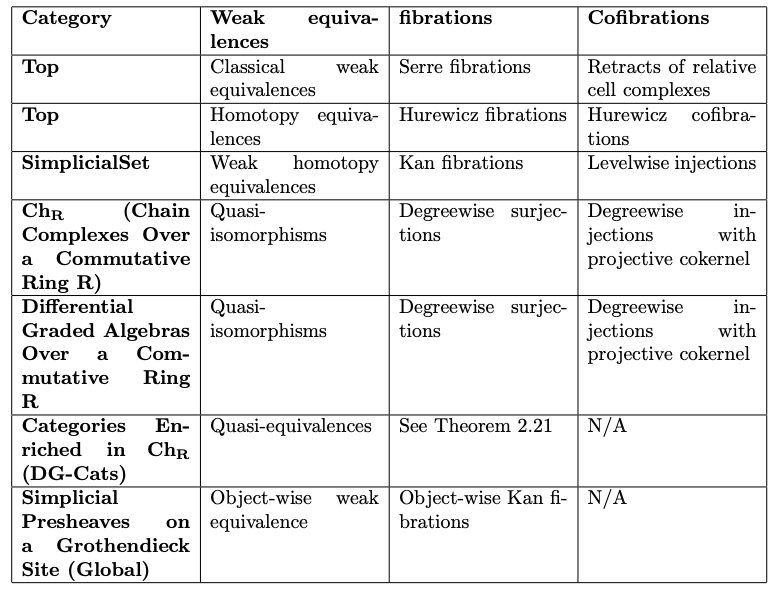
Examples include categories of topological spaces but also a more combinatorial category like simplicial sets and also chain complexes and DGAs. We can add to this list the stable homotopy category as well, the homotopy category of spectra. To define a notion of homotopy in this more generalized setting takes more work since we don’t have available to us the unit inverval $[0,1]$ in non-topological categories.
Model Category Whitehead Theorem: Suppose $X,Y$ are bifibrant objects in a model category $M$. Then $X$ and $Y$ are weakly equivalent if and only if they are homotopy equivalent.
Moreover, in the category of topological spaces, CW complexes are bifibrant objects and we can “approximate” objects by bifibrant objects. Any object $X$ in a model category has a fibrant replacement $FX$ by factoring the map $\varnothing \to X$ as a fibration followed by an acyclic cofibration. $FX \to X$ is a weak equivalence and $FX$ is fibrant. SImilarly, there is a cofibrant replacement $QX$ and $QFX$ is in fact bifibrant. For a given map $g:X \to Y$, these constructions induce maps $Fg,Qg$ as well. The model category axioms don’t require functoriality for factorizing maps so $F,Q$ might not be functors. Despite this, we can still define the homotopy category of a model category $M$.
Definition: Given a model category $M$, the homotopy category $\text{Ho}(M)$ has the same objects as $M$ but morphisms defined by $\text{Ho}(M)(X,Y) := M(QFX,QFY)$.
Since weak equivalences between bifibrant objects actually have “real” homotopy inverses by the Whitehead theorem for model categories, we have successfully localized/inverted all the weak equivalences in this homotopy category. To make this a more precise statement:
Theorem: The functor $L:M \to \text{Ho}(M)$ given by the identity on objects and $QF$ on morphisms is a localization of $M$ with respect to its weak equivalences. In other words, weak equivalences in $M$ turn into isomorphisms in $\text{Ho}(M)$. Moreover, any functor $K:M \to C$ in which weak equivalences go to isomorphisms naturally factor through $L$.
Example: Beginning with some familiar abelian category like modules over a commutative ring $R$, one can produce a category of chain complexes and specify quasi-isomorphisms as the weak equivalences; i.e. they induce isomorphisms when we take homology. The (co)fibrations are injective and projective resolutions. Then the derived category is equivalent to the homotopy category defined above.
In the category of modules over $R$, for a fixed module $B$, we have a tensoring functor $T(A) = A \otimes_R B$. This is a right exact functor and we can define a left derived functor where we take a projective resolution $… \to P_2 \to P_1 \to P_0 \to A \to 0$, remove $A$ and then tensor by $B$ to get $… \to P_2 \otimes_R B \to P_1 \otimes_R B \to P_0 \otimes_R B \to 0$. The Tor groups are the homology of this complex. Note that we did a fibrant replacement (in fact, it is a bifibrant replacement).
Quillen Equivalence
Suppose we have two categories $C,D$ (not necessarily model categories) and functors $L:C \to D$ and $R:D \to C$. We say they are adjoint, written as $L \dashv R$ if there is a natural bijection between $\hom_D(L(X),Y)$ and $\hom_C(X,R(Y))$. This bijection must be natural in both variables; i.e. commutes with morphisms in $C$ and $D$. $L$ is called the left adjoint, $R$ is the right adjoint. If $f:L(X) \to Y$ is a morphism in $D$, then its right adjunct is the morphism $f^\sharp:X \to R(Y)$ in $C$ given by the bijection. And if $g:X \to R(Y)$ is a morphism in $C$, the left adjunct is the morphism $g^\flat:L(X) \to R$.
Now, suppose further that $C,D$ are model categories and $L,R$ are adjoints satisfying either of the following equivalent conditions:
- $L$ preserves cofibrations and trivial cofibrations (acyclic cofibrations).
- $R$ preserves fibrations and trivial fibrations (acyclic fibrations)
The adjunction is called a Quillen equivalence if, for every cofibration objects $X \in C$ and every fibrant object $Y \in D$, a morphism $f:L(X) \to Y$ is a weak equivalence in $D$ if and only if its adjunct $f^\sharp:X \to R(Y)$ is a weak equivalence in $C$.
It’s important to note that $L,R$ do not typically preserve all weak equivalences. $L$ is only guaranteed to preserve weak equivalences between cofibrant objects and $R$ is only guaranteed to do so for fibrant objects. However, the Quillen adjunction does allow us to construct the total left derived functor out of $L$ which we’ll denote $\mathbf{L}L:\text{Ho}(C) \to \text{Ho}(D)$. And similarly for the total right derived functor $\mathbf{R}R:\text{Ho}(D) \to \text{Ho}(C)$. These two are equivalences of the homotopy categories.
Example: The model categories of topological spaces and simplicial sets are Quillen equivalent. The left adjoint is $|\cdot|:\text{sSet} \to \text{Top}$, the geometric realization functor. And the total singular complex functor $\text{Sing}:\text{Top} \to \text{sSet}$ is the right adjoint.
Rational Homotopy Theory
Let’s consider simply connected spaces. A rational (homotopy) equivalence is a map $f:X \to Y$ which induces isomorphisms $\pi_k(X) \otimes \mathbb{Q} \to \pi_k(Y) \otimes \mathbb{Q}$ for all $k$. One could instead require isomorphism on rational homology. This is rather astounding since homology typically terminates in finite degree but homotopy groups might not. Anyways, we say two spaces are homotopy equivalent if there is a chain of rational equivalences that connect the two. Note that they might not be composable. For example, if the two maps are rational equivalences $X \leftarrow Z \to Y$, we say that $X$ and $Y$ are rationally equivalent. The rational homotopy category has simply connected topological spaces as objects and to get the morphisms, we localize rational equivalences. So each of the maps above, for example, would have inverses.
Examples While $\mathbb{RP}^2$ is not simply connected, all its homology groups in positive degree are torsion and so it is rationally equivalent to a point. By Serre’s work, all odd dimension spheres $S^{2n+1}$ are rationally equivalent to the Eilenberg-MacLane spaces $K(\mathbb{Z},2n+1)$.
This category turns out to be equivalent to a full subcategory of rational spaces. A rational space is a simply connected CW complex where its homotopy groups are all vector spaces over $\mathbb{Q}$.
There are two basic invariants of a space $X$ in the rational homotopy category: the rational cohomology ring $H^*(X,\mathbb{Q})$ (which is a graded commutative algebra) and the differential graded Lie algebra $\pi_*(X)\otimes \mathbb{Q}$ which is defined by the Whitehead Lie bracket. I won’t go into the details of how the bracket is defined but one nice fact is, if $\mathbf{1}:S^2 \to S^2$ is the identity map, then $[\mathbf{1},\mathbf{1}] = 2\eta$ where $\eta:S^3 \to S^2$ is the Hopf fibration.
A central result of the theory is that the rational homotopy category can be described in two purely algebraic ways. First, we have a model category structure of connected differential Lie algebras (only positive degrees). Quillen showed that the rational homotopy category is equivalent to the homotopy category of connected differential graded Lie algebras. Namely, to a rational space, the associated object in the equivalent category is exactly the DGLA with the Whitehead bracket.
Second, there is also a model category of 1-connected differential graded cocommutative coalgebras. The 1-connectedness means support only in degrees at least 2. Quillen showed that the rational homotopy category is equivalent to the homotopy category of 1-connected differential graded cocommutative coalgebras. The associated coalgebra to a rational space $X$ is its rational homology which can be given a coalgebra structure by using the diagonal map $\Delta:X \to X \times X$. The dual vector space is the rational cohomology ring (like de Rham differential forms) which is related to Sullivan’s approach to rational homotopy theory and minimal models.
Koszul duality between the commutative and Lie operads brings together Quillen and Sullivan’s work. But one can also contextualize this in terms of Quillen equivalences. Unfortunately, we cannot directly say that the spatial realization functor from DGCAs to spaces and the polynomial de Rham algebra functor form a Quillen equivalence. There are technicalities such as finiteness, nilpotency, and covariance/contravariance of functors. However, one can establish a Quillen adjunection between a functor of simplicial realization (send a DGCA to a simplicial set) and the polynomial de Rham algebra functor.
Indeed, I believe all of the following model categories have equivalent homotopy categories (for reference, see this survey):
- simply connected spaces with rational equivalences being the weak equivalence
- rational spaces: simply connected spaces whose homotopy groups are $\mathbb{Q}$-vector spaces
- differential graded Lie algebras over $\mathbb{Q}$
$L_\infty$-algebras over $\mathbb{Q}$
- 1-connected differential graded cocommutative coalgebras over $\mathbb{Q}$